
Building handwriting skills and confidence through meaningful, structured practice.
Does your child have fantastic ideas but struggle to get them onto paper? Do they write slowly, complain that their hand hurts or become frustrated when asked to complete written work?
Perhaps their written work simply doesn't reflect what you know they are capable of.
Understanding the reasons behind these difficulties is essential to providing the right support.
Understanding the term dysgraphia
Here in Spain, parents and teachers may be familiar with the term disgrafía when discussing handwriting and writing difficulties.
However, terminology and assessment practices differ internationally.
Within UK specialist assessment practice, dysgraphia is not recognised as a distinct formal diagnostic category. Instead, the emphasis is on identifying the underlying difficulties affecting handwriting and written expression.
This distinction is important because writing difficulties can arise for many different reasons, and the support needed will depend on the individual's profile.
Writing is more complex than we might think
When we write, we bring together a number of different skills simultaneously.
These include:
Motor coordination and pencil control.
Remembering and forming letters automatically.
Retrieving spelling patterns.
Organising thoughts and ideas.
Holding information in working memory.
Maintaining attention and concentration.
Monitoring and reviewing what we have written.
When one or more of these processes is not working efficiently, writing can become slow, demanding and exhausting.
Recognising the different types of writing difficulty
Handwriting and graphomotor difficulties
Graphomotor skills involve coordinating the movements needed to produce handwriting.
An individual experiencing difficulties in this area may demonstrate:
Slow or laborious handwriting.
Inconsistent letter formation.
Irregular letter size and spacing.
Difficulty keeping writing on the line.
Excessive pencil pressure.
Hand fatigue or discomfort.
Reduced legibility when attempting to write quickly.
Difficulties with written expression
Some individuals can form letters perfectly well but struggle when they need to produce their own written work.
They may experience difficulties with planning, organising ideas, spelling, constructing sentences or remembering what they intended to write.
A student may be able to explain a concept confidently in conversation but produce very little when asked to write about it.
Cognitive load and writing
When handwriting and spelling require considerable conscious effort, fewer mental resources are available for developing and expressing ideas.
Imagine trying to remember what you want to say whilst simultaneously concentrating on how to form each letter and spell each word.
Writing can become overwhelming, particularly under time pressure.
This is why simply asking a student to write more, write faster or try harder may not be the solution.
Understanding the individual through assessment
As a specialist teacher assessor, I investigate the different factors that may be contributing to an individual's writing difficulties.
This may include exploring:
Handwriting speed and fluency.
Letter formation and legibility.
Differences between copying and independent writing.
Spelling and written expression.
The impact of working memory and cognitive load.
The effects of fatigue and time pressure.
Importantly, I look beyond assessment scores to consider how the individual approaches writing and the impact these difficulties have on everyday learning.
Where appropriate, further investigation by an occupational therapist or another specialist may be recommended.
The aim is to understand the individual's strengths and difficulties and identify meaningful, practical support.
Supporting handwriting at home
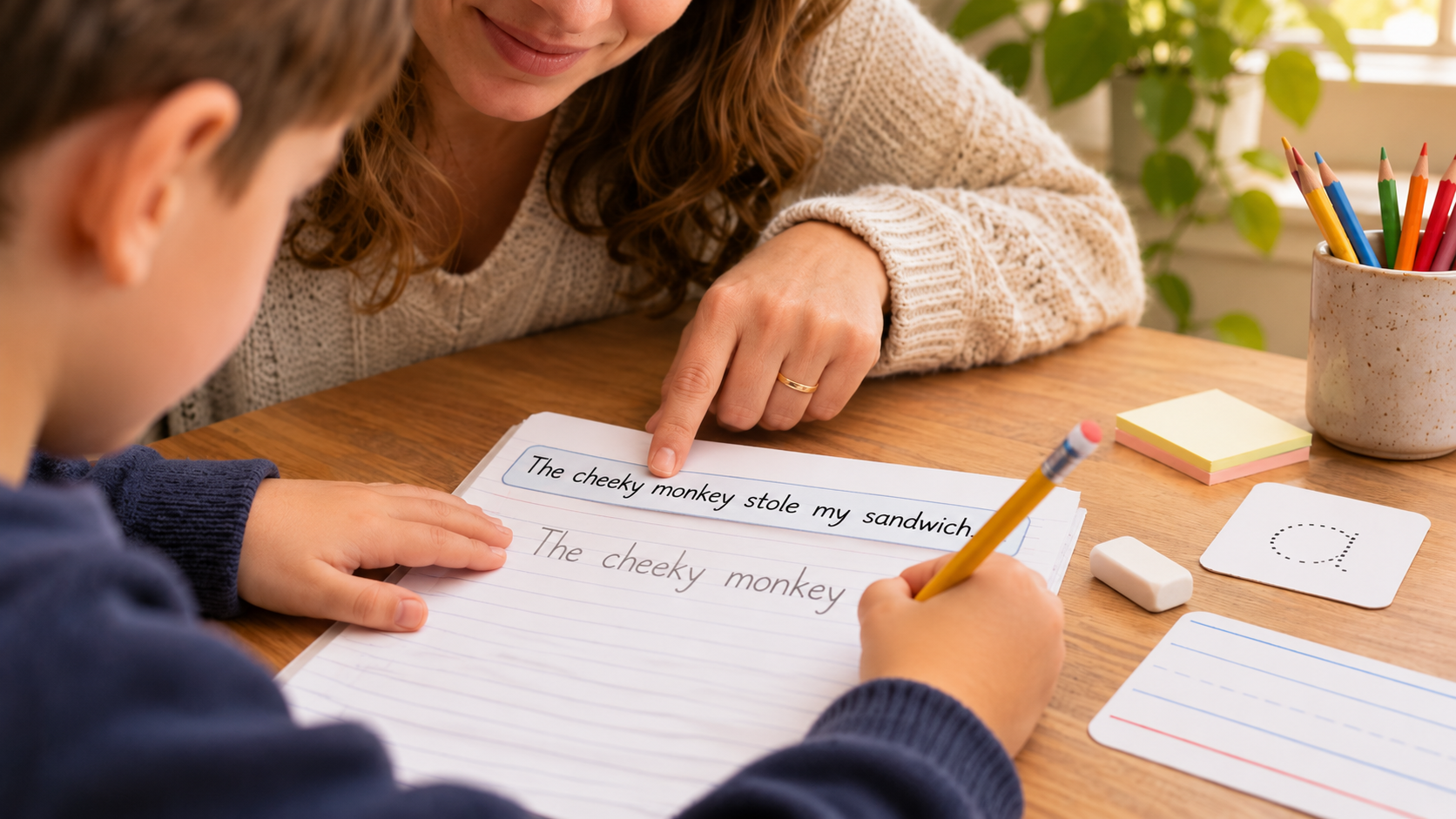
For children who need to develop handwriting fluency and letter formation, short, regular and focused practice can be beneficial.
Rather than completing pages of handwriting exercises, try five minutes of purposeful practice four or five times a week.
A simple five-minute routine:
Check that your child is sitting comfortably, with their feet supported and their paper positioned appropriately.
Choose one or two letters to practise, focusing on correct formation.
Copy a short, interesting sentence.
Write one original sentence using the same handwriting focus.
Identify something that has improved and celebrate that progress.
Focus on one target at a time, such as spacing, letter size or alignment.
Encourage accuracy and consistency before increasing speed. The aim is comfortable, legible and increasingly automatic handwriting, rather than perfect presentation.
If handwriting causes pain or significant fatigue, seek professional advice rather than increasing the amount of practice.
Useful handwriting resources for parents
The following websites offer practical guidance and activities to support handwriting development.
National Handwriting Association
An excellent starting point for understanding handwriting difficulties and accessing practical advice.
Oxford Owl
Age-appropriate handwriting activities and guidance for parents.
https://home.oxfordowl.co.uk/english/primary-handwriting/
Occupational Therapy Support Hub
Practical strategies for developing handwriting and fine motor skills.
Supporting learners beyond handwriting practice
Not every writing difficulty can be addressed through handwriting exercises alone.
Some learners may benefit from additional strategies, including:
Developing keyboard skills.
Using speech-to-text technology.
Planning ideas verbally before writing.
Using mind maps and writing frameworks.
Reducing unnecessary copying.
Appropriate examination access arrangements, where eligibility requirements are met.
These strategies can be particularly important for older students, university students and adults.
Looking beyond the handwriting
One of the most important aspects of my work as a specialist teacher and assessor is understanding why an individual is experiencing difficulty, rather than simply identifying what they find difficult.
With appropriate support, we can help learners develop their skills and confidence while ensuring that writing difficulties do not prevent them from demonstrating their knowledge and abilities.
At Dysl3xia, based in Es Capdellà, Mallorca, I provide specialist dyslexia and literacy assessments and individualised literacy support in English for children, young people and adults.
If you have concerns about handwriting or written expression, please feel free to get in touch.